Make video
Bánh mì ổ
A 9:16 storyboard, 114 seconds of edit time. Scene lengths are cuts, not the minutes the pot actually needs. Music mood: Soft acoustic guitar, warm room tone, no lyrics.
Scene 1 · hook · 4s
Hook
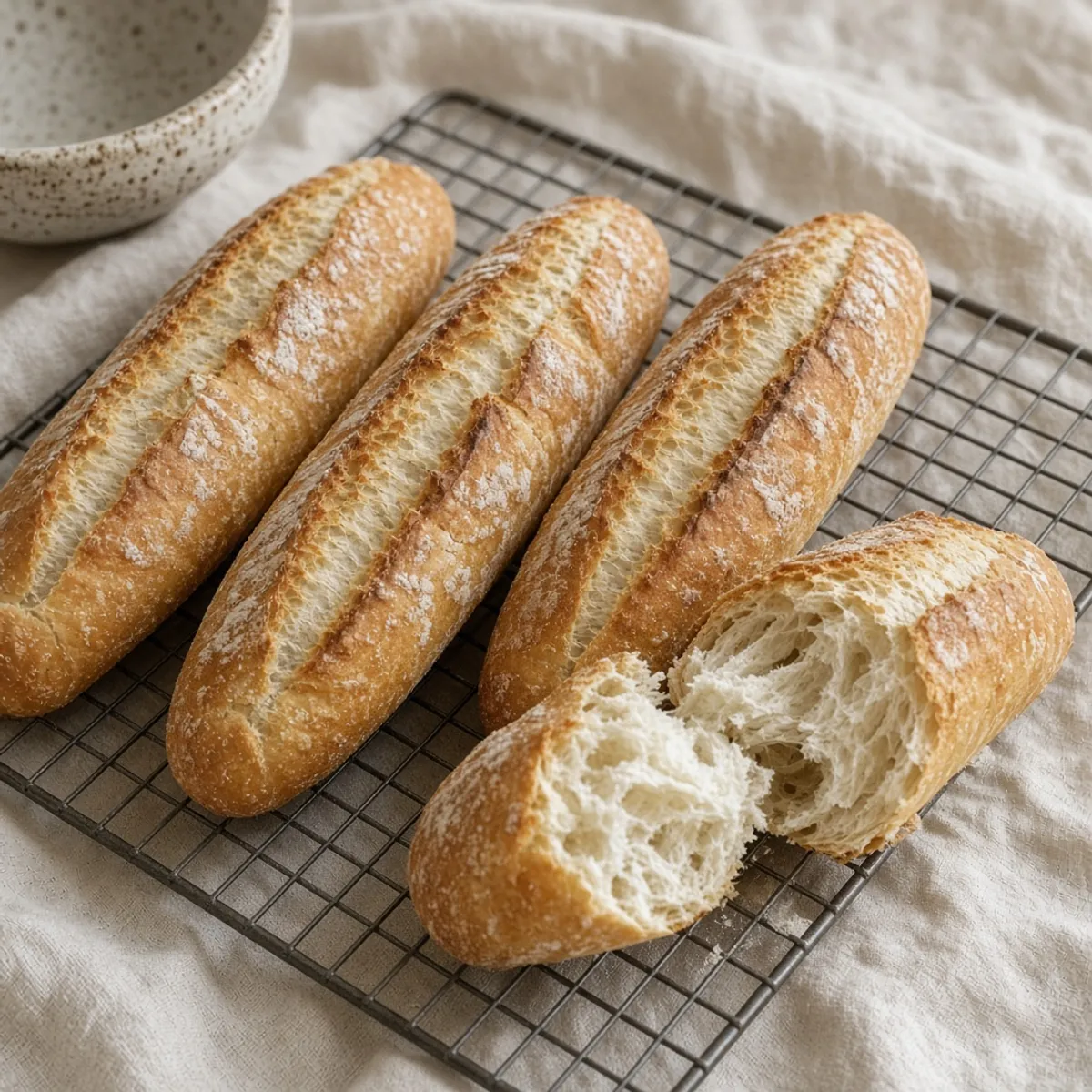
Shot. Open tight on the finished Bánh mì ổ, then pull back just enough to see the plate. Ivory linen, warm window light, no faces, no logos, no text burned into the picture.
Voiceover. Bánh mì ổ. A crackly Vietnamese baguette from a home oven, with a thin crust and a cottony crumb. Here is the whole thing, one move at a time.
On screen. Bánh mì ổ
Scene 2 · title · 4s
Open on the finished dish
Shot. Slow push-in on the finished Bánh mì ổ, ivory linen, a gold spoon just out of focus. No faces. No logos.
Voiceover. Bánh mì ổ. A crackly Vietnamese baguette from a home oven, with a thin crust and a cottony crumb.
On screen. Bánh mì ổ
Scene 3 · ingredients · 6s
Mise en place
Shot. Overhead flat lay. Hands set down small bowls in a quiet rhythm. Labels stay out of frame.
Voiceover. Set out bread flour, water, active dry yeast, granulated sugar, kosher salt. Measure before the pan is hot.
On screen. Mise en place
Scene 4 · equipment · 5s
Equipment
Shot. A slow pan across the tools on the counter, then back to the bowl. No brand logos.
Voiceover. You need Scale, Large bowl, Bench scraper, Sheet pan, Parchment, Oven, A second pan for water, Cooling rack.
On screen. Scale · Large bowl · Bench scraper
- 🇻🇳 VietnamSoutheast Asiavn-banh-mi-o-nha-vn-banh-mi-o-nha-5
Step 1
step · vietnam
Scene 5 · step · 7s
Step 1
Shot. Bánh mì ổ: flour and a jug of water on a scale. Natural window light, ivory linen, handmade ceramic, shallow depth of field, no text, no logo, no watermark, fine-dining magazine photograph. Show the action, then a jump cut through the wait. Do not film the full Weigh 2 min in real time.
Voiceover. Weigh 500 g bread flour into a large bowl. Weigh 340 g water at about 24°C / 75°F into a jug. If the water is warmer than 32°C / 90°F, the yeast will rush and the crumb will collapse.
On screen. Weigh 500 g bread flour into a… · Weigh 2 min
- 🇻🇳 VietnamSoutheast Asiavn-banh-mi-o-nha-vn-banh-mi-o-nha-6
Step 2
step · vietnam
Scene 6 · step · 7s
Step 2
Shot. Bánh mì ổ: shaggy dough resting in a bowl. Natural window light, ivory linen, handmade ceramic, shallow depth of field, no text, no logo, no watermark, fine-dining magazine photograph. Show the action, then a jump cut through the wait. Do not film the full Rest 20 min in real time.
Voiceover. Stir the flour and water with a spoon until no dry flour remains. Cover the bowl. Let this rough dough rest 20 minutes on the counter. Do not add salt yet. The rest lets the flour drink the water so the loaf stays soft.
On screen. Stir the flour and water with a… · Rest 20 min
- 🇻🇳 VietnamSoutheast Asiavn-banh-mi-o-nha-vn-banh-mi-o-nha-7
Step 3
step · vietnam
Scene 7 · step · 7s
Step 3
Shot. Bánh mì ổ: a hand stretching a thin window of dough. Natural window light, ivory linen, handmade ceramic, shallow depth of field, no text, no logo, no watermark, fine-dining magazine photograph. Show the action, then a jump cut through the wait. Do not film the full Knead 8 min in real time.
Voiceover. Sprinkle 6 g active dry yeast, 16 g sugar, 9 g kosher salt, and 12 g neutral oil over the dough. Knead in the bowl for 8 minutes, until the dough is smooth and stretches to a thin window without tearing. If it tears, knead 2 minutes more. The dough will feel sticky. Do not add flour.
On screen. Sprinkle 6 g active dry yeast, 16 g… · Knead 8 min
- 🇻🇳 VietnamSoutheast Asiavn-banh-mi-o-nha-vn-banh-mi-o-nha-8
Step 4
step · vietnam
Scene 8 · step · 7s
Step 4
Shot. Bánh mì ổ: doubled dough with a finger dent. Natural window light, ivory linen, handmade ceramic, shallow depth of field, no text, no logo, no watermark, fine-dining magazine photograph. Show the action, then a jump cut through the wait. Do not film the full Proof 60 min in real time.
Voiceover. Cover the bowl. Set the dough to proof in a warm spot, about 27°C / 80°F, for 60 minutes. At 30 minutes, wet one hand and fold the dough in half once. It is ready when it has doubled and a floured finger leaves a dent that springs back slowly.
On screen. Cover the bowl. Set the dough to… · Proof 60 min
- 🇻🇳 VietnamSoutheast Asiavn-banh-mi-o-nha-vn-banh-mi-o-nha-9
Step 5
step · vietnam
Scene 9 · step · 7s
Step 5
Shot. Bánh mì ổ: four pieces of dough on the counter. Natural window light, ivory linen, handmade ceramic, shallow depth of field, no text, no logo, no watermark, fine-dining magazine photograph. Show the action, then a jump cut through the wait. Do not film the full Rest 15 min in real time.
Voiceover. Scrape the dough onto a barely oiled counter. Divide it into 4 pieces of about 220 g each. Shape each piece into a loose log. Cover with a towel and rest 15 minutes so the dough relaxes before the final roll.
On screen. Scrape the dough onto a barely… · Rest 15 min
- 🇻🇳 VietnamSoutheast Asiavn-banh-mi-o-nha-vn-banh-mi-o-nha-10
Step 6
step · vietnam
Scene 10 · step · 7s
Step 6
Shot. Bánh mì ổ: slim logs proofing on a sheet. Natural window light, ivory linen, handmade ceramic, shallow depth of field, no text, no logo, no watermark, fine-dining magazine photograph. Show the action, then a jump cut through the wait. Do not film the full Proof 40 min in real time.
Voiceover. Roll each piece into a 20 cm / 8 inch log, pinching the seam closed. Set the logs seam-down on a parchment-lined sheet, 5 cm / 2 inches apart. Cover. Proof 40 minutes, until they look puffy and a gentle poke fills back halfway. Start the oven now, not after they are fully risen.
On screen. Roll each piece into a 20 cm / 8… · Proof 40 min
- 🇻🇳 VietnamSoutheast Asiavn-banh-mi-o-nha-vn-banh-mi-o-nha-11
Step 7
step · vietnam
Scene 11 · step · 7s
Step 7
Shot. Bánh mì ổ: a split loaf going into a steamy oven. Natural window light, ivory linen, handmade ceramic, shallow depth of field, no text, no logo, no watermark, fine-dining magazine photograph. Show the action, then a jump cut through the wait. Do not film the full Bake 12 min at 230°C / 446°F in real time.
Voiceover. Heat the oven to 230°C / 446°F. Put an empty metal pan on the bottom rack. When the loaves are puffy, brush each top with water and press one deep split down the length with the side of a chopstick. Slide the sheet onto the middle rack. Pour 200 g water into the hot pan. Shut the door at once. Bake 12 minutes with the steam.
On screen. Heat the oven to 230°C / 446°F. Put… · Bake 12 min at 230°C / 446°F
- 🇻🇳 VietnamSoutheast Asiavn-banh-mi-o-nha-vn-banh-mi-o-nha-12
Step 8
step · vietnam
Scene 12 · step · 7s
Step 8
Shot. Bánh mì ổ: crackly gold loaves on a rack. Natural window light, ivory linen, handmade ceramic, shallow depth of field, no text, no logo, no watermark, fine-dining magazine photograph. Show the action, then a jump cut through the wait. Do not film the full Bake 9 min at 200°C / 392°F in real time.
Voiceover. Take the water pan out. Turn the oven down to 200°C / 392°F. Bake 8 to 10 minutes more, until the crust is deep gold, crackly, and the loaf sounds hollow when you tap the bottom. If the top is pale, give it 3 minutes. If it is already dark, pull it.
On screen. Take the water pan out. Turn the… · Bake 9 min at 200°C / 392°F
- 🇻🇳 VietnamSoutheast Asiavn-banh-mi-o-nha-vn-banh-mi-o-nha-13
Step 9
step · vietnam
Scene 13 · step · 7s
Step 9
Shot. Bánh mì ổ: a cooled loaf torn open to show the crumb. Natural window light, ivory linen, handmade ceramic, shallow depth of field, no text, no logo, no watermark, fine-dining magazine photograph. Show the action, then a jump cut through the wait. Do not film the full Cool 20 min in real time.
Voiceover. Cool the loaves on a rack for 20 minutes before you cut them. Cutting hot bread presses the crumb into a paste. The crust should shatter, and the inside should be open and cottony, not wet.
On screen. Cool the loaves on a rack for 20… · Cool 20 min
Scene 14 · doneness · 6s
How you know it is done
Shot. Close on the center of the food. A skewer, tap, or spoon shows the cue. Hold long enough to see it.
Voiceover. The crust crackles when pressed, the color is deep gold rather than blond, and a tap on the bottom sounds hollow. The crumb is open and dry to the touch, not gummy.
On screen. Doneness
Scene 15 · mistakes · 7s
If it goes wrong
Shot. Split screen is unnecessary. Show the finished, correct texture, then a hand points at the cue.
Voiceover. The crust is hard and the crumb is tight. The dough was too dry or the steam pan was empty. Next time keep all 340 g of water and pour water into the hot pan as the bread goes in. The loaves spread into flat ovals. They proofed too long, or the seam was on top. Next time shape tighter and bake when a poke springs back halfway, not when the dough looks exhausted.
On screen. Common fixes
Scene 16 · storage · 5s
Cooling and storage
Shot. The dish cools on a rack, then a container is closed. No refrigerator brand in frame.
Voiceover. Keep the loaves in a paper bag the same day. The crust softens overnight. Refresh one loaf at 180°C / 356°F for 5 minutes. Freeze the rest the day you bake them, well wrapped, for a month.
On screen. Storage
Scene 17 · nutrition · 5s
Nutrition lower third
Shot. Hold on a single serving. A quiet lower third fades in. No medical claims on screen.
Voiceover. One serving is about 498 calories, with 15.6 grams of protein. Pai marks it Moderate.
On screen. 498 kcal · 15.6 g protein · Moderate
Scene 18 · plate · 5s
Plate and close
Shot. Spoon or tongs place the last garnish. Pull back to the full plate. End on steam or a still surface.
Voiceover. Serve 4 loaves. Eat while it is at its best.
On screen. Bánh mì ổ
Scene 19 · cta · 4s
Close
Shot. Hold the finished plate. A quiet end card can fade in after the picture. Do not cover the food with a logo.
Voiceover. Cook Bánh mì ổ from the Pai recipe. The amounts, the heat, and the moment to stop are written under each step.
On screen. Cook it from the recipe
Machine-readable script for a later video tool. Scene durations are edit lengths, not cooking times. Long simmers and bakes are jump cuts. Order: hook, title, mise, equipment, one scene per numbered step (shot, on-screen text, voiceover, duration), doneness, fixes, storage, nutrition, plate, and the closing CTA. Keep the shot list and on-screen facts tied to this recipe.